
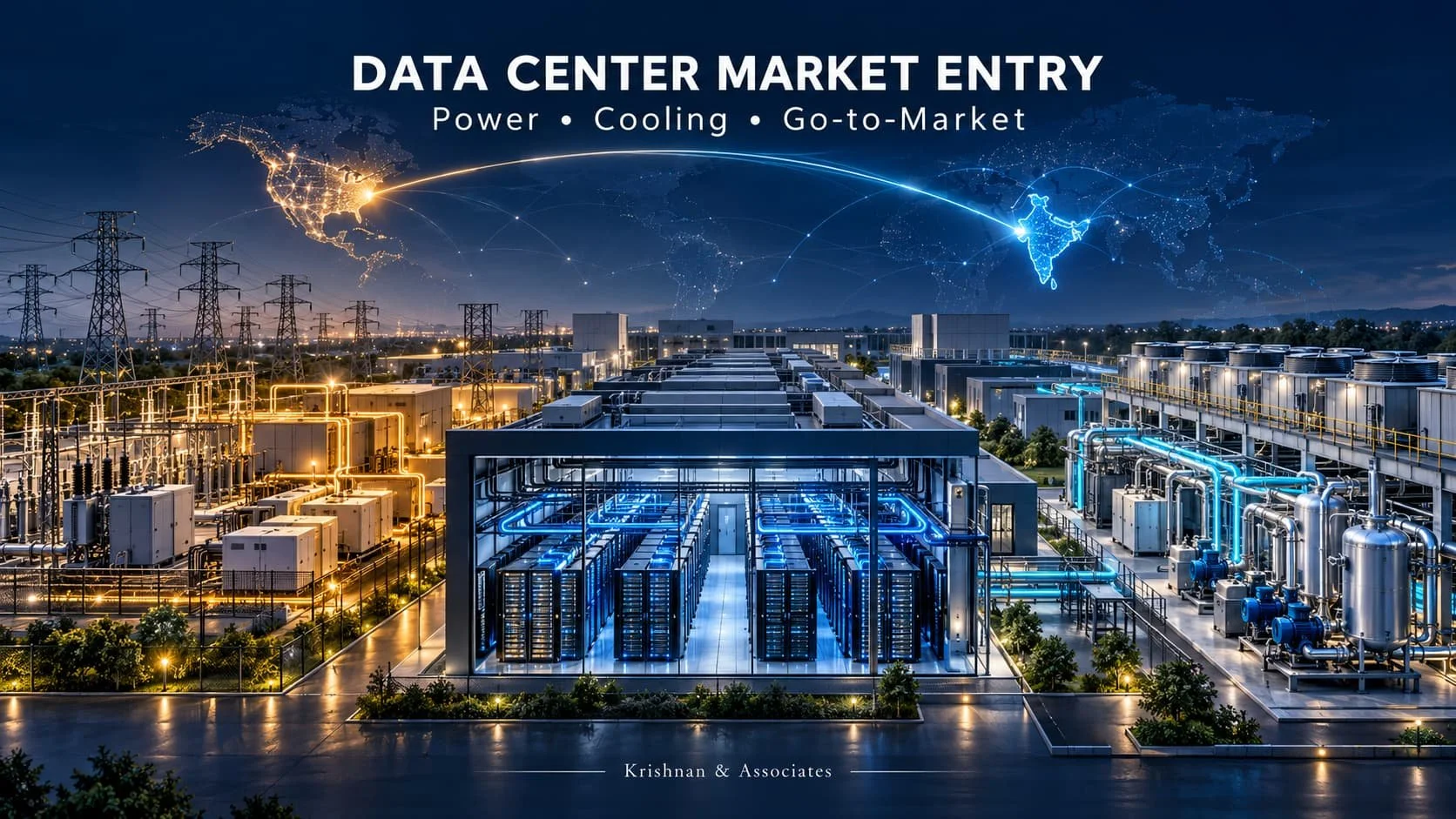
AI infrastructure is creating enormous opportunities for companies that manufacture power, cooling, electrical and thermal-management equipment. Yet entering the data-center market is rarely as simple as adapting an existing industrial product and presenting it to a hyperscaler or colocation operator.
The data center is an interconnected power-and-thermal system. Cooling architecture affects electrical demand, usable IT capacity, water consumption, facility layout, capital cost and deployment schedules. Power availability, in turn, influences site selection, redundancy, cooling design and the pace at which capacity can be brought online.
Companies entering this market must therefore solve two challenges simultaneously:
Develop a technically credible solution for the data-center operating environment.
Build a go-to-market strategy that connects the solution to the correct buyers, projects, partners and qualification pathways.
There Is No Universal Data-Center Cooling Architecture
The growth of high-density AI computing is accelerating interest in direct-to-chip liquid cooling, coolant distribution units and higher-temperature facility water systems. However, this does not mean every data center will adopt the same cooling architecture.
The right solution depends on several site- and customer-specific considerations:
IT load and expected rack density.
Current and future proportion of air- and liquid-cooled equipment.
Local ambient temperature and humidity.
Water availability and restrictions.
Available electrical capacity.
Roof, plant-room and campus space.
Redundancy and reliability requirements.
Approved equipment manufacturers.
Construction and commissioning schedules.
Maintenance and equipment-replacement access.
Local manufacturing, transportation and lifting constraints.
A conventional air-cooled system may remain appropriate for one project, while another may benefit from a centralized water-cooled plant. Water-constrained locations may favor dry cooling, while high-ambient regions may require hybrid or adiabatic assistance during peak conditions.
Liquid-cooled AI infrastructure adds another layer. The facility cooling system must interface properly with CDUs, secondary distribution piping, rack manifolds and server-level cooling technology. Responsibility for these interfaces must be clear, particularly when several OEMs, contractors and technology providers are involved.
The market is consequently moving away from evaluating individual pieces of equipment in isolation. Owners increasingly want an integrated system with defined performance, controls, testing, commissioning and accountability.
Power and Cooling Must Be Evaluated Together
A data center may secure a certain amount of utility or onsite generation capacity, but not all of that power reaches the servers. Chillers, pumps, fans, dry coolers, controls and other facility systems consume part of the available electrical supply.
Cooling architecture can therefore influence how much revenue-producing IT capacity a site can support.
The comparison should extend beyond the rated efficiency of a chiller. It should include:
Pumping and distribution energy.
Fan and heat-rejection loads.
Part-load performance.
Peak ambient conditions.
Controls and auxiliary loads.
Redundancy philosophy.
Water treatment and storage.
Residual air-cooling requirements.
Annual operating profile.
Maintenance and replacement requirements.
The lowest-water solution may not deliver the lowest energy consumption. The most efficient full-load equipment may not be the best performer across an actual annual load profile. A highly modular system may accelerate construction but introduce transportation, structural or interface considerations.
This is why credible comparisons should use consistent system boundaries, weather data, load assumptions and redundancy requirements. Otherwise, competing architectures are not being evaluated on an equivalent basis.
The same integrated thinking applies to data-center power infrastructure. Grid availability, backup generation, bridging power, substations, electrical distribution and future campus expansion must be coordinated with the thermal design. Power and cooling cannot be developed as separate commercial conversations.
Why Strong Industrial Companies Still Struggle to Enter the Market
Many energy and industrial companies possess relevant technologies, engineering resources and manufacturing capabilities. What they often lack is a clear path into the data-center ecosystem.
The customer landscape is more complicated than it first appears. Potential decision-makers include:
Hyperscalers and AI infrastructure companies.
Colocation operators and data-center developers.
Owner’s engineering teams.
EPC and design-build contractors.
Architecture and engineering firms.
MEP contractors.
Commissioning authorities.
Cooling and electrical OEMs.
Rack, server and liquid-cooling technology providers.
Local manufacturing and installation partners.
Each group evaluates a new solution differently. An owner may prioritize lifecycle performance and repeatability. An EPC may focus on scope boundaries, risk and schedule. An engineering consultant may require hydraulic, structural, CFD and acoustic validation. Procurement may require approved factories, operating references and auditable pricing.
A technically strong provider can therefore spend months approaching the wrong people with the wrong message.
How K&A Helped Open the U.S. and Indian Data-Center Markets for a New Entrant
Krishnan & Associates recently supported an established energy and thermal-engineering provider seeking to expand into the data-center market. The company possessed deep heat-transfer, engineering and global manufacturing capabilities, but it was a relatively new participant in mission-critical cooling.
The initial proposition centered on factory-integrated cooling systems and customized high-capacity CDUs. Rather than immediately launching a broad promotional campaign, K&A treated the engagement as a structured market-entry and customer-validation exercise.
The first step was mapping the ecosystem across the United States and India. This included data-center operators, developers, engineering firms, EPCs, equipment manufacturers and potential execution partners.
K&A then facilitated direct discussions with senior technical, engineering, procurement and management stakeholders. These conversations were designed to test the proposition—not simply promote it.
The market feedback quickly sharpened the strategy.
Customers were interested in modularization, but they wanted evidence that it could reduce construction risk, support faster capacity deployment and provide repeatable quality. They also wanted clarity around transportation, lifting, maintenance access, controls, factory testing and site commissioning.
Interest in customized CDUs was accompanied by questions about full-load testing, secondary piping, BMS integration, documentation, operating references and responsibility through commissioning.
Indian customers also emphasized localization. They wanted to understand which facilities would manufacture the systems, how production would scale, which approved OEMs could be incorporated and who would manage field installation and support.
These insights changed the conversation from: “Here is a modular cooling product.” to:
“Here is a potential industrialized delivery platform that can be configured around your approved equipment, site constraints and performance requirements.”
That distinction was essential.
Within a concentrated market-development effort, the provider moved from being largely unknown in the data-center sector to participating in senior-level technical discussions in both the United States and India. The engagement generated potential concept studies, prototype discussions, qualification pathways and strategic-partner conversations.
No confidential customer information or premature commercial claims are required to understand the lesson: market access came from combining technical positioning, direct customer intelligence, executive engagement and disciplined follow-up.
The Objective Is Not Always an Immediate Sale
Complex infrastructure markets rarely move directly from an introductory presentation to a purchase order.
A more credible progression may involve:
An initial technical and commercial discussion.
An NDA and exchange of a representative design basis.
A project-specific concept or feasibility study.
A comparison against the incumbent architecture.
A prototype or proof-of-concept system.
Factory and third-party performance testing.
Vendor qualification and approval.
Deployment on an initial project.
Repeat production across a larger program.
A good go-to-market partner must understand this journey. Generating a list of contacts is not enough. The partner must help determine what evidence the customer needs, who influences the decision, how the product fits into the project-delivery structure and what must happen before procurement can act.
What an Effective Data-Center GTM Partner Should Provide
For companies entering the data-center power, cooling or infrastructure markets, the right commercialization partner should combine:
Data-center and energy-domain knowledge.
Access to owners, operators, EPCs and engineering firms.
Market and competitive intelligence.
Voice-of-customer research.
Technical value-proposition development.
Identification of project-specific use cases.
Partner and channel development.
Executive-level business development.
Thought leadership and market education.
Support through qualification, pilots and early deployments.
This combination is especially important for overseas companies entering the United States or India. Technology must be translated into the customer’s operating, commercial and project-delivery context.
From Technology Provider to Credible Market Participant
Data-center demand is creating a significant opportunity for companies with capabilities in power generation, grid infrastructure, thermal management, modular construction, controls, water systems and industrial manufacturing.
But the market is technically demanding, risk-conscious and highly interconnected. Success requires more than a strong product.
It requires understanding how the customer’s power, cooling, space, water, schedule and reliability requirements come together—and then positioning the provider within the ecosystem responsible for delivering the complete facility.
Krishnan & Associates helps energy and infrastructure companies make that transition. By combining market intelligence, technical positioning, industry relationships, targeted outreach and customer validation, K&A helps new and established providers identify where they can compete, gain access to the right stakeholders and build a practical route from market entry to qualified opportunity.
For companies evaluating the U.S., Indian or global data-center markets, the first question should not simply be, “Who can buy our product?”
It should be:
“Where does our capability solve a meaningful data-center problem, and what technical, commercial and partnership pathway will allow the market to adopt it?”