
What Technology Providers Must Understand Before Entering the Market
- By Ravi Krishnan | Founder, Krishnan & Associates, Inc.
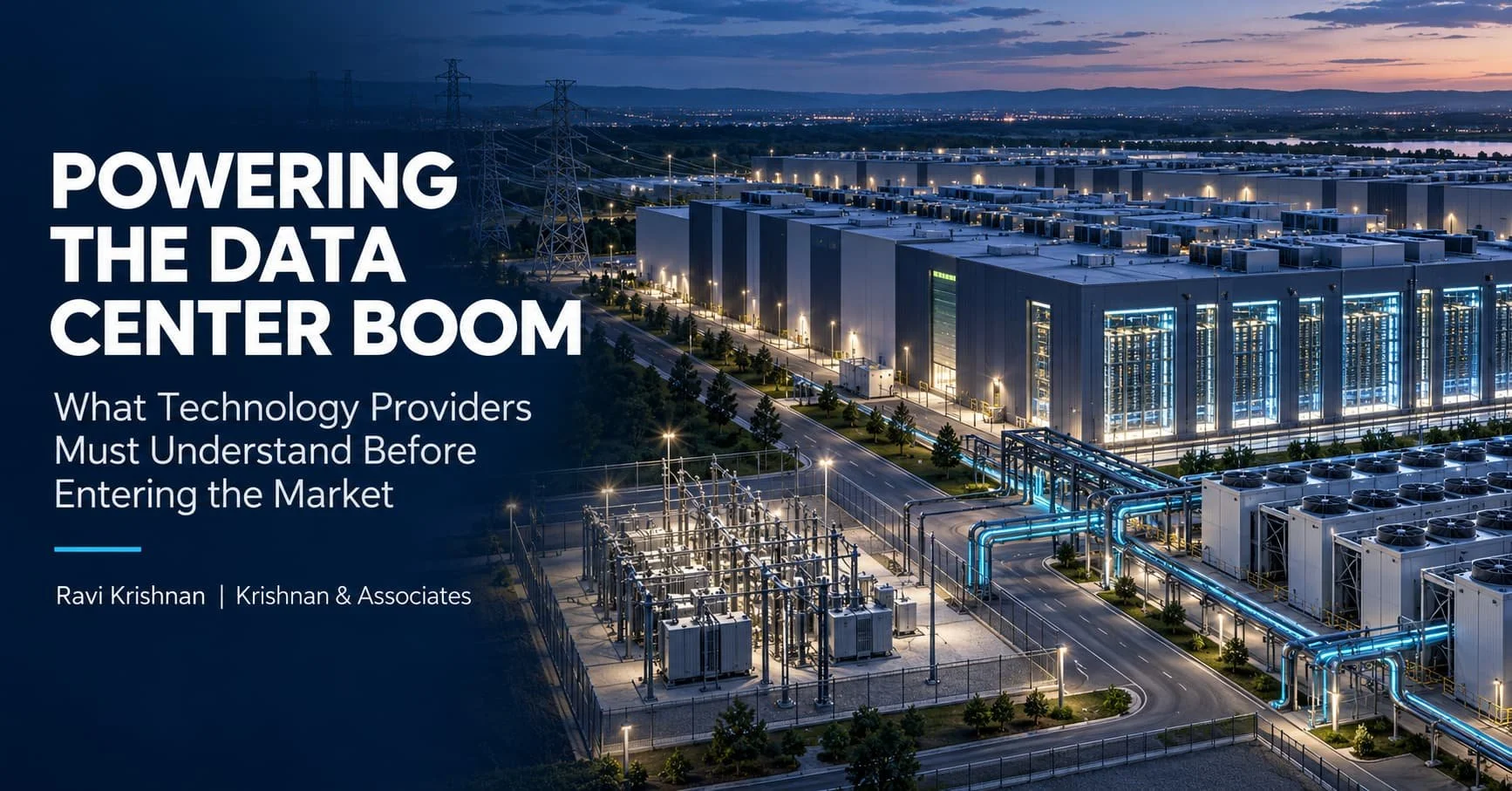
AI is accelerating data center construction, but the industry’s defining constraint is no longer compute alone. It is the ability to secure firm power, reject heat, integrate complex systems and commission usable capacity on a committed schedule. For technology providers, succeeding in this market requires understanding the entire decision ecosystem—not simply presenting a better component.
Data centers have moved from being relatively invisible commercial loads to becoming major pieces of industrial infrastructure. The International Energy Agency estimates that global data center electricity consumption rose 17% in 2025, reaching about 485 terawatt-hours, and could roughly double to 950 TWh by 2030. In the United States, Lawrence Berkeley National Laboratory estimated that data centers consumed 176 TWh in 2023, or 4.4% of national electricity use, with a wide projected range of 325 to 580 TWh by 2028.
Those numbers explain why utilities, power producers and equipment manufacturers are pursuing the sector. But rapid load growth does not make the data center market a conventional equipment sale. The customer is buying resilient, operable and revenue-producing IT capacity. Every proposed technology is judged by whether it helps deliver that outcome without introducing unacceptable design, schedule or operational risk.
The central commercial lesson: data center customers do not buy equipment in isolation. They buy firm megawatts, uptime, speed to revenue and controlled execution risk.
Power—not equipment—is the product
For a developer, the critical metric is not simply nameplate megawatts. It is firm, deliverable, redundant and permit-ready power available by a date that supports customer commitments. Reaching that point may require new generation, transmission upgrades, substations, transformers, switchgear, uninterruptible power supplies, batteries, backup generation and cooling infrastructure. A delay in any one element can strand the rest of the investment.
AI further complicates the power profile. Higher rack densities increase both electrical and thermal loads, while some AI workloads can create rapid power swings. Behind-the-meter generation, microgrids and storage are therefore attracting attention, but they are not automatic shortcuts around grid constraints. The IEA estimates that reliable onsite natural-gas generation for critical and variable data center loads may require 30% to 70% more installed generating capacity than demand. Fuel supply, emissions, permitting, islanding, black-start capability, maintenance and synchronization with the grid all have to be engineered as one system.
Understand who actually controls the decision
The data center ecosystem contains several customers within one project. A hyperscaler or enterprise end user may establish global requirements for rack density, redundancy, equipment makes and operating performance. A colocation developer controls the real estate, capital program, schedule and many procurement decisions. The utility or system operator controls interconnection timing and available grid capacity. The architect-engineer or owner’s engineer translates customer standards into the basis of design and evaluates alternatives. The EPC contractor or general contractor determines constructability and manages site interfaces. Operators, insurers, authorities having jurisdiction and local communities influence maintainability, safety, water, noise and emissions.
The economic buyer, technical specifier and final approver are therefore often different organizations. A supplier can have an enthusiastic meeting with a developer and still fail because the engineering consultant will not specify an unqualified design, the end customer will not accept a vendor outside its approved vendor list, or the contractor sees unresolved installation and warranty boundaries. Effective market development begins by mapping this decision chain project by project.
Enter before the design is frozen
Technology providers frequently arrive after the cooling architecture, electrical topology, voltage level, structural loads and equipment rooms have already been established. At that point, even a technically superior alternative can create redesign risk that outweighs its benefits. The best opening is during site selection, concept development or early basis-of-design work, when the owner and engineer can still compare architectures fairly.
An early-stage package should go beyond a brochure. It should include performance assumptions, a process flow or piping and instrumentation diagram, an electrical single line, footprint and weight, transport and lifting plans, maintenance and replacement paths, control philosophy, redundancy, interfaces, commissioning requirements and a credible schedule. For modular systems, the comparison must include every field connection and all equipment outside the factory-built enclosure. A compact skid is not a compact plant if heat-rejection equipment, service clearances or interconnecting headers are excluded.
Market outcomes, not isolated efficiency claims
The strongest value propositions are expressed in business outcomes: megawatts of IT capacity enabled, months removed from the schedule, land or rooftop area recovered, annual energy and water saved, and availability improved. Claims should be compared against the customer’s baseline under the same load, climate, redundancy and operating assumptions.
Power usage effectiveness remains useful, but it is often misused. PUE is total facility energy divided by IT equipment energy; it does not measure water consumption or IT efficiency. Uptime Institute’s 2025 survey reported a weighted average PUE of 1.54, while also emphasizing substantial variation by facility age, size and climate. Suppliers should state whether they are discussing total facility PUE, partial PUE or subsystem efficiency. A chiller or UPS manufacturer cannot independently guarantee the PUE of an entire facility. At a 100-MW IT load, however, a genuine 0.05 improvement in facility PUE represents 5 MW less facility demand at that operating point—enough to have real commercial value.
Cooling illustrates why the analysis must be site-specific. Evaporative systems can reduce electricity use but consume water. Air-cooled systems avoid water but may require more footprint and power under high ambient conditions. Water-cooled chillers paired with dry coolers can reduce consumptive water use, yet add pumps, piping and heat-rejection equipment. Liquid cooling can support high-density racks, but introduces coolant distribution units, water-quality requirements and new technology-to-facility interfaces. No architecture wins everywhere.
Reliability and execution come before novelty
Data centers are risk-averse for good reason. A new product must demonstrate not only efficiency but also failure-mode behavior, N+1 or 2N redundancy, power-source transfer, controls integration, cybersecurity, service access, spare-parts availability and recovery time. Factory-built modularization can improve quality and reduce site work, but it also raises practical questions about transportation, crane access, structural loading, acoustic treatment, fire protection and how major components will be replaced after the building is operating.
References remain the strongest currency. Where operating references do not yet exist, suppliers should offer a disciplined qualification path: transparent design calculations, third-party review, component testing, integrated factory acceptance testing, performance guarantees and a well-defined pilot or proof of concept. Local engineering, fabrication, commissioning and service capability matter as much as the pedigree of the technology’s parent company.
Winning by reducing project risk
The data center opportunity is large, but it will not reward generic claims or a one-size-fits-all architecture. The successful technology provider understands the site’s physical constraints, the end customer’s standards, the engineer’s evidence requirements, the contractor’s interfaces and the operator’s long-term needs. It enters early, defines exactly what is included, quantifies the outcome and proves reliability.
The most effective market question is therefore not, “Will the customer buy our technology?” It is, “Which project constraint can we remove, who must approve the solution, and what evidence will allow them to do so?” Suppliers that can answer those questions will become part of the data center delivery ecosystem rather than remaining outside it with an interesting product.
Source notes
International Energy Agency, Key Questions on Energy and AI, 2026
Lawrence Berkeley National Laboratory, 2024 United States Data Center Energy Usage Report
Uptime Institute, Global Data Center Survey 2025