
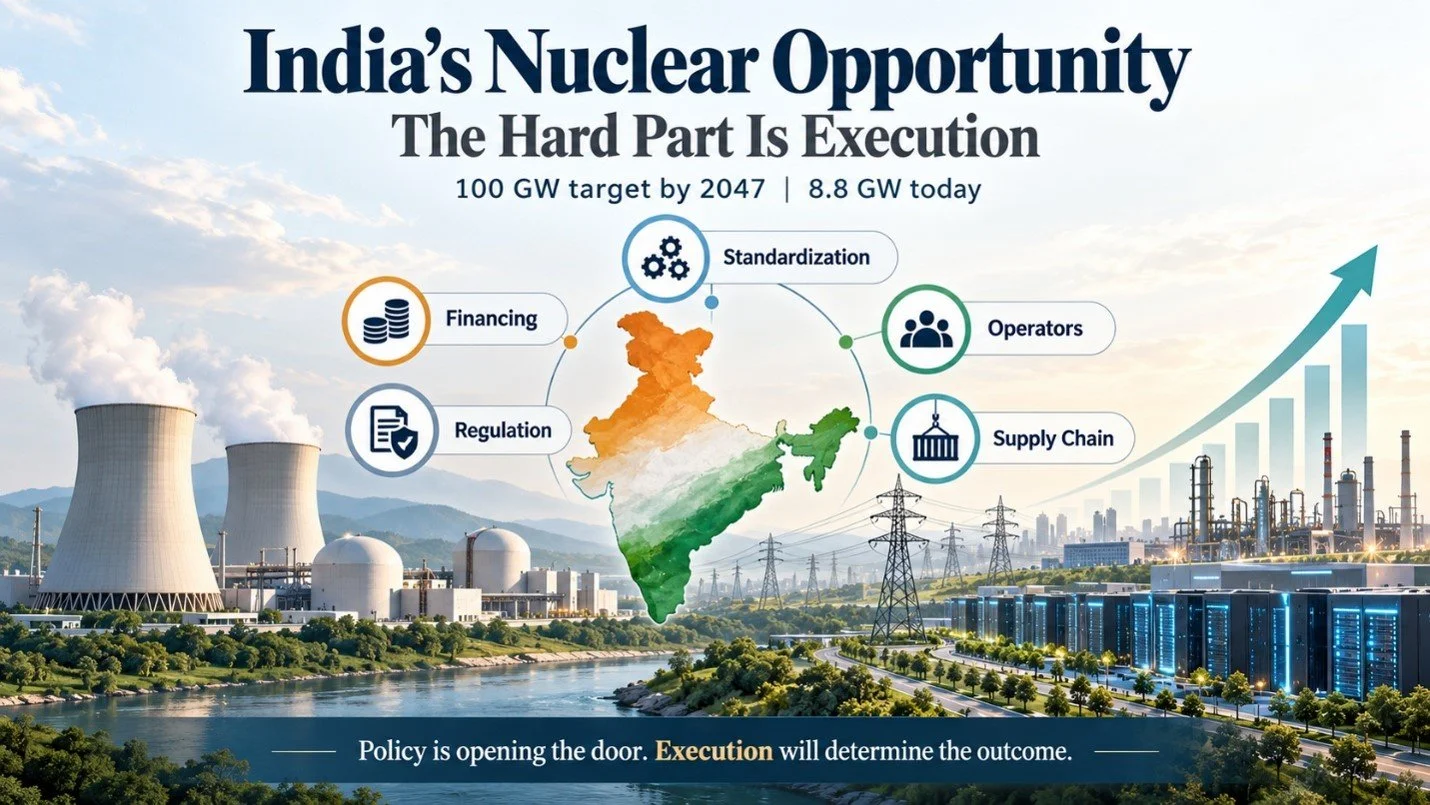
India’s nuclear power ambitions are entering a very different phase.
The country is targeting 100 GW of nuclear capacity by 2047, up from less than 10 GW today. At the same time, the SHANTI reforms are opening the door to broader participation from public-sector companies, joint ventures, and private industry.
On paper, the opportunity is enormous.
But K&A’s recent market research suggests that the real question is no longer whether India needs nuclear power.
It is whether India can finance, build, license, and operate nuclear plants repeatedly enough—and predictably enough—to reach that scale.
That distinction matters.
Nuclear Demand Is Getting Stronger
Globally, the nuclear conversation has shifted.
For several years, nuclear was discussed primarily in the context of decarbonization. Today, another force is becoming equally important: rapidly growing demand for reliable 24/7 electricity.
AI data centers, semiconductor manufacturing, industrial reshoring, electrification, and other large loads are changing power-market fundamentals.
That creates a strong case for firm generation.
For countries with large existing nuclear fleets, the most attractive opportunity is often extending the life of existing reactors. K&A’s research suggests that operating lives of 80 years and potentially longer will increasingly be considered where technically and safely feasible.
The economics are compelling because the original capital investment has already been made.
India, however, has a different challenge.
It does not simply need to preserve existing nuclear generation. It needs to build a very large amount of new capacity.
New Nuclear Still Has a Cost Problem
The challenge is capital cost.
Industry discussions continue to place some new nuclear and first-of-a-kind SMR projects at costs that can exceed $10,000/kW, compared with roughly $2,000/kW for new gas generation under current market conditions.
These are not universal benchmarks. Nuclear costs depend heavily on reactor design, country, construction schedule, localization, and financing.
But the gap illustrates the fundamental issue.
A nuclear plant can operate for decades and ultimately deliver highly competitive firm power, but enormous amounts of capital must be invested before the first megawatt-hour is sold.
That makes financing and risk allocation central to nuclear development.
Future projects may therefore require much greater cooperation among governments, utilities, technology providers, industrial customers, data center operators, and long-term investors.
SMRs Could Help—But Only If They Become Repeatable
Small modular reactors are frequently presented as a potential solution.
Their smaller size and modular construction could make nuclear more flexible and open applications in industrial facilities, data centers, remote grids, and potentially retiring coal sites.
India is developing several indigenous SMR concepts and has identified SMRs as an important part of its future nuclear strategy.
But there is an important caveat.
Small does not automatically mean inexpensive.
The economic promise of SMRs comes from standardization, factory manufacturing, and repetition.
The important question is therefore not whether India can build its first SMR.
It is whether the country can build the 10th, 20th, and 50th unit faster and cheaper than the first.
India Needs Nuclear Fleets, Not One-Off Projects
This may be the biggest lesson from successful nuclear programs globally.
Countries that repeatedly build standardized reactor designs generally perform better than those that treat every nuclear plant as a unique megaproject.
Standardization allows engineering to be reused, suppliers to invest with confidence, construction teams to retain experience, and regulators to become familiar with designs.
India already understands this through its domestic PHWR program.
Reaching 100 GW will likely require taking that philosophy much further.
The industry needs to think less about individual projects and more about repeatable nuclear fleets.
NTPC and Private Industry Could Become Important
The expanding role of NTPC could also prove significant.
NPCIL will remain central to India’s nuclear program, but NTPC brings decades of experience developing large power plants, managing EPC projects, raising capital, and procuring equipment.
That could make NTPC an important bridge between India’s traditional nuclear establishment and the wider commercial power sector.
Private-sector participation could add additional capital, manufacturing capability, and project-development expertise.
But private participation also raises the bar for licensing and regulation.
Nuclear power requires a safety culture and institutional capability that must be maintained for decades.
Opening the market therefore cannot simply be about allowing more companies to invest.
It must also be about developing qualified nuclear owners and operators.
The Bigger Opportunity Is the Supply Chain
India’s nuclear ambitions could also create a much broader industrial opportunity.
A large nuclear construction program requires thousands of components and services—pumps, valves, piping, heat exchangers, instrumentation, electrical systems, controls, sensors, cranes, inspection technologies, cooling systems, robotics, cybersecurity, and specialized engineering.
India already has deep manufacturing capability across thermal power, oil and gas, aerospace, electrical equipment, and heavy engineering.
With the necessary nuclear qualifications, many of these companies could become part of a much larger domestic nuclear supply chain.
India therefore has the potential not simply to build nuclear plants, but to become a major global nuclear manufacturing and engineering hub.
The Real Challenge Is Execution
India has several advantages: rapidly growing electricity demand, strong engineering capabilities, an established nuclear base, large industrial companies, and now a policy framework supporting broader participation.
But the 100-GW target will ultimately depend on execution.
The central issue is whether India can combine:
standardized designs, low-cost long-term capital, experienced operators, scalable regulation, and a strong domestic supply chain.
That is the real opportunity—and the real risk.
K&A explores these issues in greater detail in our forthcoming POWER Magazine article, including nuclear economics, SMR commercialization, NTPC’s potential role, private-sector participation, and what India can learn from successful fleet-based nuclear programs around the world.
The opportunity is substantial.
The next test is turning policy into projects—and projects into a repeatable nuclear industry.