
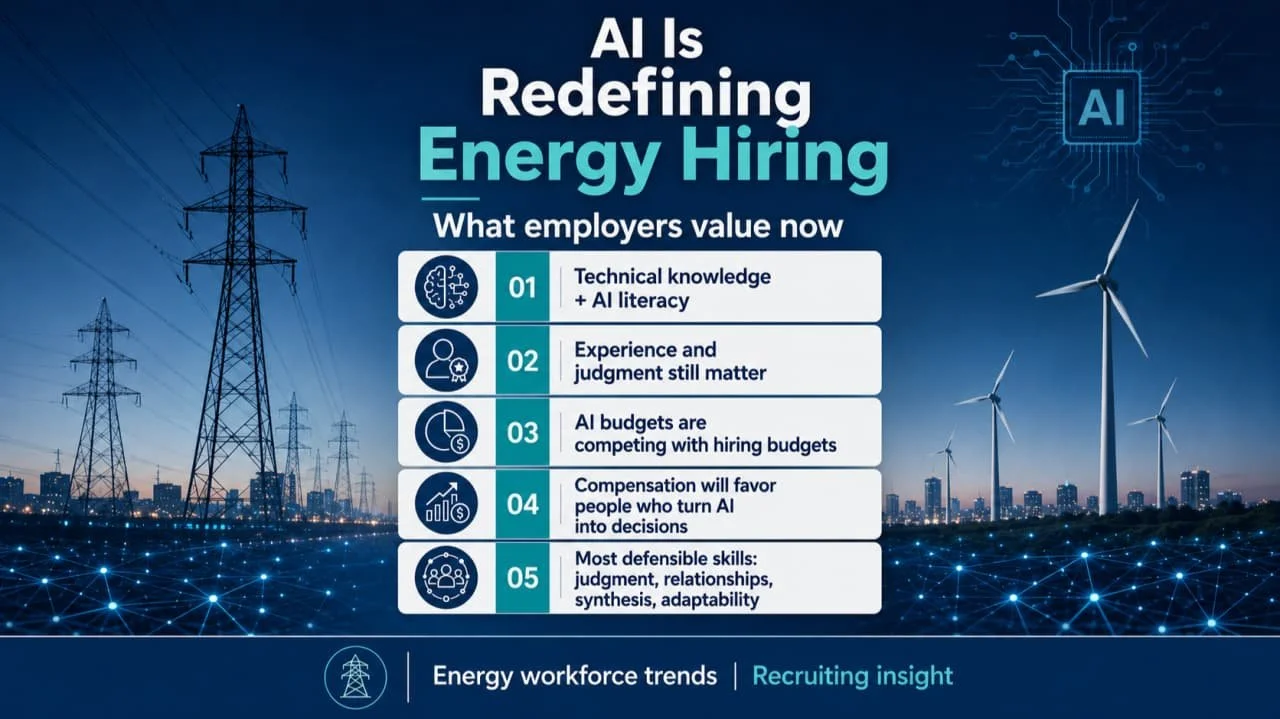
Artificial intelligence is changing the energy workforce, but perhaps not in the way many people initially expected. The most important question is no longer simply whether AI will replace jobs. It is how AI is changing the skills companies value, the positions they are willing to fund, and the compensation they offer for different types of work.
As a recruiter and consultant serving the energy and infrastructure industries, I increasingly see a separation between routine work that can be accelerated by AI and work that still requires experience, judgment, relationships and technical accountability.
The energy industry has always required specialized knowledge. Utilities, power producers, grid technology companies, engineering firms, data-center developers and energy equipment suppliers operate in environments where mistakes can be expensive and, in some cases, affect reliability and safety. AI can analyze documents, prepare initial research, compare technical specifications and produce a credible first draft. However, it may not recognize when its conclusion is technically unrealistic, commercially outdated or based on incomplete information. This is creating a new hiring standard.
Technical Knowledge Is No Longer Enough
Historically, companies often hired people primarily for their ability to perform a defined technical function. Today, employers increasingly expect professionals to combine technical knowledge with data literacy, commercial awareness and the ability to use AI productively.
An engineer may be expected to use AI to organize technical information but must still validate the output. A market analyst may use AI to review utility filings and industry reports but must determine which findings are commercially meaningful. A communications professional may use AI to prepare a draft but must understand the technology well enough to identify errors and explain it accurately.
The valuable employee is therefore not necessarily the person who produces the first draft. It is the person who knows whether the draft is correct. This is particularly important in energy, where publicly available information may be incomplete, outdated or easy to misinterpret. AI may estimate when a utility is likely to replace an operational system, upgrade a power plant or invest in grid modernization. But confirming the opportunity may still require current conversations with utility executives, engineers, operators and procurement teams.
Experience Is Becoming More Valuable, Not Less
There is a common assumption that AI reduces the value of experienced professionals because it allows less-experienced employees to produce more sophisticated work. In practice, the opposite may also be happening.
AI raises the baseline quality of routine output. Almost anyone can now generate a report, presentation, job description or market summary. The differentiator is the ability to challenge the output, identify what is missing and add insights based on years of practical experience.
This creates an opportunity for senior energy professionals who are prepared to adjust how they work. Instead of completing every assignment from the beginning, experienced professionals may increasingly serve as reviewers, advisers and subject-matter experts. They can guide younger teams, validate AI-assisted research, participate in important customer discussions and recognize subtleties that a general-purpose AI platform may overlook.
Companies should therefore be cautious about eliminating senior expertise simply because routine drafting and research can be automated. Once institutional knowledge is lost, it is difficult to reconstruct.
Hiring Budgets and AI Budgets Are Beginning to Compete
Another developing issue is the relationship between technology spending and compensation.
Large corporations are investing heavily in enterprise AI platforms, data infrastructure, cybersecurity and specialized applications. Some of this funding may come from budgets that would previously have supported additional employees, training programs, salary increases or outside consultants.
Management teams will eventually ask whether these investments are generating measurable returns. Does an additional AI platform produce more value than hiring an experienced engineer, recruiter, salesperson or analyst? Can the technology operate independently, or does it require skilled people to review and apply its output? The likely answer will not be AI or people. It will be a carefully designed combination of both.
Employees who can demonstrate that they improve the return on a company’s AI investment may command stronger compensation. These professionals will know how to ask better questions, verify results, protect confidential information and convert analysis into decisions.
The Most Defensible Skills Are Human
Several capabilities are likely to remain especially valuable in the energy job market:
Technical judgment will remain important because someone must accept responsibility for whether an analysis or recommendation is correct.
Relationship development will continue to matter because major energy purchases are rarely made based only on automated research or digital communication.
Commercial synthesis will become more important because companies need professionals who can connect technology, regulation, customer priorities and competitive positioning.
Communication will remain essential because complex technologies must be explained clearly to executives, investors, regulators and customers.
Adaptability may become the most important skill of all. Energy professionals cannot ignore AI, but they also should not assume that using AI automatically makes their work valuable.
What This Means for Energy Employers and Candidates
Employers should redesign roles around outcomes rather than lists of routine tasks. They should identify which activities can be accelerated through AI and which require human validation, customer interaction or technical accountability. Candidates should focus on demonstrating how they use AI rather than merely stating that they are familiar with it. They should be prepared to explain how they verify information, where they apply professional judgment and how their work improves a commercial or operational result.
AI will undoubtedly eliminate certain tasks and reduce demand for some traditional positions. At the same time, it will create stronger demand for professionals who combine technology with experience, credibility and judgment.
The future energy workforce will not be divided simply between humans and machines. It will be divided between people who use AI to produce more content and people who use it to make better decisions.
Ravi Krishnan is the Founder of Krishnan & Associates, Inc., an energy-industry marketing, market analytics and business-development consulting firm. The company also operates a specialized global recruitment practice that has successfully placed more than 1,000 executives, C-suite leaders and technical professionals across the energy industry.
With decades of experience supporting utilities, power producers, engineering firms and energy technology companies, Ravi brings a practical perspective on how artificial intelligence, evolving skill requirements and changing compensation priorities are reshaping the global energy workforce.