
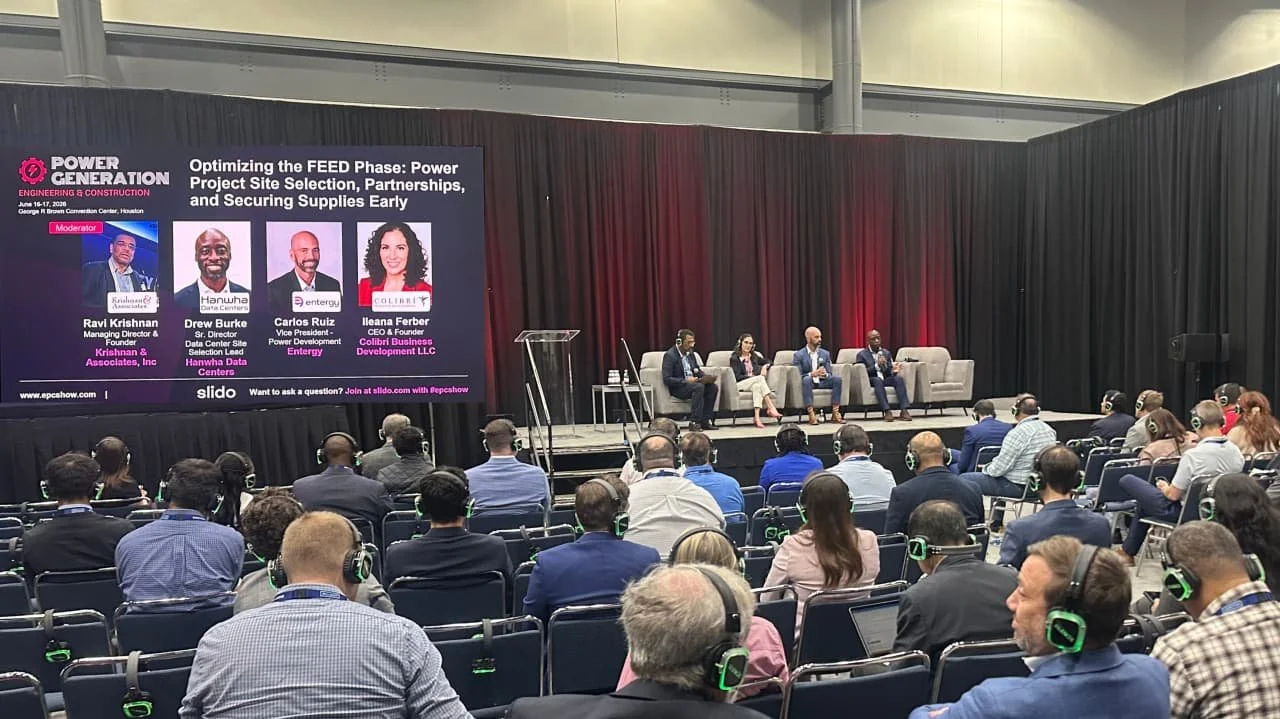
I had the opportunity to moderate a panel at EPC Show 2026 on:
“Optimizing the FEED Phase: Power Project Site Selection, Partnerships, and Securing Supplies Early.”
I was joined by an excellent group of panelists: Andrew Burke of Hanwha Data Centers, who brought a data center site-selection and power-infrastructure perspective; Carlos Ruiz, P.E. of Entergy , who shared a utility generation and project-development view; and Ileana Ferber, MBA of Colibrí Business Development LLC, who brought deep expertise in local content, supplier development, and workforce planning.
While each panelist approached the topic from a different angle, one message came through clearly:
FEED has become one of the most strategic stages of project development.
Traditionally, FEED was viewed primarily as a technical design and estimating exercise. Today, it is where owners, developers, EPCs, suppliers, communities, and regulators must begin aligning around the issues that will ultimately determine whether a project can be delivered.
Drew highlighted that for data center development, power strategy must be part of the conversation from the very beginning. Site selection is no longer just about land availability or customer proximity. It is increasingly about power availability, transmission access, substation planning, schedule certainty, and the flexibility to support future growth.
Carlos reinforced this from the power generation side. He explained how early-stage development has changed dramatically, particularly as long-lead equipment and supply-chain constraints have become central to project viability. Owners can no longer wait until EPC award to think about transformers, turbines, electrical equipment, or other critical components. These decisions now need to be addressed much earlier.
A key point Carlos raised was the value of standardization. In today’s market, repeatable designs can help accelerate FEED, reduce uncertainty, improve procurement planning, and make projects easier to replicate across multiple sites.
Ileana brought an important dimension that is often overlooked: local content. She emphasized that local content is not something to solve during construction. It needs to be built into project planning from the start. Supplier mapping, workforce assessments, skills-gap analysis, training needs, and stakeholder expectations should all be considered during FEED.
Her point was especially relevant because local content affects more than compliance. It can influence financing, regulatory approvals, community acceptance, workforce readiness, and execution risk.
The panel also discussed the growing importance of community engagement and permitting. A technically strong project can still face delays if the community is not aligned or if permitting agencies are overwhelmed. These are no longer secondary issues. They are core project risks.
Another theme that came through strongly was flexibility. Drew noted that data center customers and power requirements continue to evolve quickly, which means developers need flexible contracts, designs, phasing strategies, and infrastructure plans. In a market where requirements can change rapidly, rigidity creates risk.
The broader takeaway was clear:
Projects are no longer delayed only by engineering complexity. They are delayed by unresolved risks that should have been addressed earlier.
Those risks may involve power availability, permitting, local workforce capacity, equipment lead times, community acceptance, or supplier readiness.
Perhaps the strongest closing message came from Carlos:
“Tomorrow’s project will be more expensive than today’s project.”
That is a powerful reminder for everyone involved in large infrastructure, power generation, and data center development.
In today’s environment, FEED is not just about defining the project. It is about de-risking the project.
Thank you to Drew, Carlos, Ileana, and the Energy Projects Conference & Exhibition audience for an excellent discussion.
Ravi Krishnan is the Founder of Krishnan & Associates, Inc., an energy-industry marketing, market analytics and business-development consulting firm. The company also operates a specialized global recruitment practice that has successfully placed more than 1,000 executives, C-suite leaders and technical professionals across the energy industry.
With decades of experience supporting utilities, power producers, engineering firms and energy technology companies, Ravi brings a practical perspective on how artificial intelligence, evolving skill requirements and changing compensation priorities are reshaping the global energy workforce.