

For much of the past decade, the U.S. power generation market appeared to be moving in a fairly predictable direction. Coal capacity would continue to decline, natural gas would take a larger share of dispatchable generation, renewables would expand, and many older generating assets would gradually move toward retirement.
The direction of travel has not necessarily changed, but the operating reality has.
Rapid growth in electricity demand from data centers, AI infrastructure, manufacturing investment and broader electrification is placing greater pressure on the existing generation fleet. At the same time, renewable intermittency continues to increase the importance of dispatchable generation.
The result is a market in which both coal and natural gas plants are being asked to do more—and technology and service providers need to adjust the way they approach these customers.
Coal: A Smaller Market, but a More Relevant One Than Many Expected
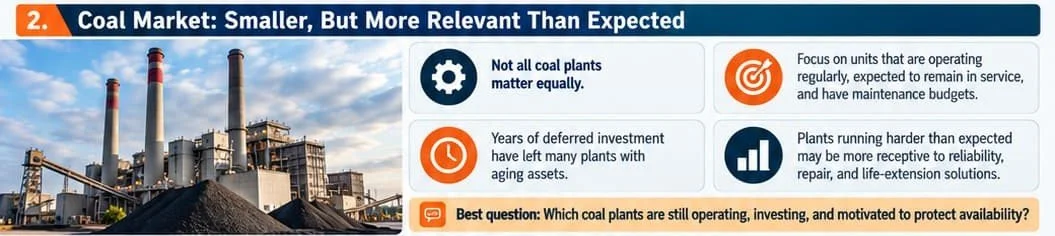
Coal remains a declining resource over the long term. However, that does not mean the remaining market should be treated as irrelevant.
For more than a decade, many coal plants operated under what could reasonably be described as a maintenance-only philosophy. Owners expected units to retire, major capital improvements were difficult to justify, and maintenance spending was often focused on doing what was necessary to keep equipment operating.
That environment created an aging fleet in which some assets experienced years of deferred investment.
Today, a number of these plants are being called upon more frequently because the system needs dependable generation while new capacity, transmission and other infrastructure catch up with demand growth.
For suppliers, this creates a very specific opportunity.
The attractive coal market is not simply "all coal plants."
A 700-MW unit approaching retirement may be a far less attractive prospect than a 250-MW unit expected to operate for another decade.
The more useful questions are:
Is the plant actually operating?
At what capacity factor?
Is the owner expecting it to remain in service?
Is maintenance spending available?
Is the facility running harder than it did several years ago?
What equipment problems are becoming more important as the unit ages?
Does the plant have an economic incentive to maintain availability?
This is why market intelligence has become so important.
A database containing every coal-fired unit in the United States may appear valuable, but treating all of those units equally can waste substantial sales resources. The greater value comes from identifying the subset of plants that are operating regularly, expected to remain viable and willing to invest in maintenance and reliability.
Gas Generation Faces a Different Problem
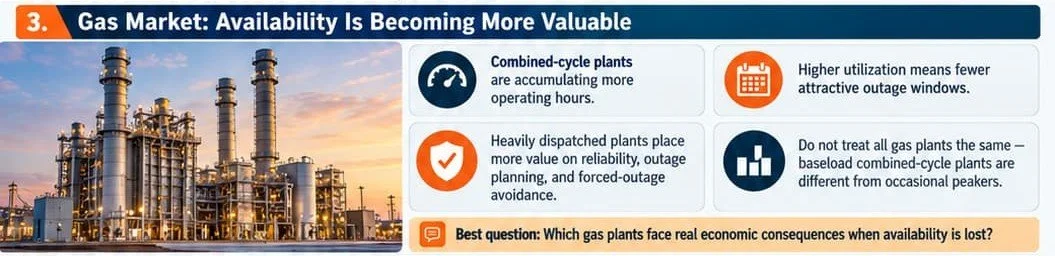
The opportunity in natural gas is broader, but the market needs to be segmented just as carefully.
Combined-cycle plants are increasingly central to U.S. grid reliability. In many regions, units that were originally expected to operate flexibly or at intermediate duty are accumulating substantially more operating hours.
This changes the economics of maintenance.
When a plant operates only a few hundred hours per year, taking it offline may not represent a significant commercial problem. When the same facility is operating thousands of hours and is needed by the grid, every outage window becomes more valuable.
This creates growing attention around:
HRSG performance
Feedwater and condensate systems
Cooling-water systems
Balance-of-plant piping
Valves and flanges
Outage planning
Reliability
Heat rate
Asset life
Forced-outage avoidance
For companies selling into gas generation, the key is to avoid treating every gas plant as the same market.
A low-utilization simple-cycle peaker and a heavily dispatched combined-cycle plant have very different operating priorities.
The best prospects are increasingly the plants where availability carries a measurable economic value.
The Common Theme: Availability

Although the coal and gas markets are different, they are converging around one important issue: availability.
The traditional sales approach often begins with the technology:
"We provide coatings."
"We provide composite repairs."
"We provide monitoring."
"We provide boiler services."
"We provide leak repair."
Coal plants may be operating longer than owners originally anticipated.
Combined-cycle plants may be operating more hours than originally anticipated.
In both situations, the consequence of equipment failure becomes more important.
For maintenance and reliability providers, this changes the customer conversation.
That is rarely the strongest opening message.
Plant personnel are usually more interested in the operating consequence:
Can this help avoid a forced outage?
Can we remain online until the scheduled outage?
Can this reduce a derate?
Can we extend the life of an existing asset?
Can we fix the problem without a major capital project?
Can the supplier respond quickly when something fails?
The technology matters, but the economic and operational outcome usually gets the first meeting.
Marketing to Plants Requires More Than a Large Contact Database

Power generation remains a relationship-driven market.
Plant Managers, Maintenance Managers, Operations Managers, Reliability Engineers, Performance Engineers, Boiler Specialists, HRSG Engineers and fleet-level technical personnel all view problems from slightly different perspectives.
That means effective marketing requires more than sending the same message to thousands of contacts.
The strongest campaigns increasingly combine several elements.
Case histories.
Plant personnel respond strongly to examples from comparable facilities, particularly when results can be quantified.
Thought leadership.
Technical articles and industry publications provide credibility before the direct sales conversation takes place.
Digital reinforcement.
Email, LinkedIn and targeted industry advertising can keep a supplier visible between buying events.
Market segmentation.
Identify the plants where the application and economics actually make sense.
Technical positioning.
Translate the product or service into the operating problem the plant is trying to solve.
Direct engagement.
Telephone and personal outreach still matter enormously in the generation market.
Technical education.
Webinars, lunch-and-learns and application discussions allow engineers to understand where a technology fits—and where it does not.
No single channel normally produces the entire result.
The objective is to create familiarity so that when a plant develops a problem, the supplier is already known.
The Importance of Timing
This is particularly important for services associated with unexpected equipment problems.
Consider an external piping leak that develops several months after an outage.
The plant has two choices: shut down and perform a conventional repair, or determine whether an engineered alternative can safely allow continued operation until the next planned outage.
That purchasing decision may occur very quickly.
A supplier trying to introduce itself for the first time during the emergency is already at a disadvantage.
The companies that tend to receive the call are those whose names the maintenance and reliability teams already recognize.
That is why marketing in the power sector should not be viewed simply as generating an immediate sales lead. Part of the objective is establishing technical familiarity before the requirement appears.
Fleet-Level Relationships Are Becoming More Important
Another frequently overlooked opportunity is the fleet.
Many suppliers successfully execute work at one generating station but never systematically expand into sister plants owned or operated by the same organization.
The first project may be the most difficult.
Once vendor qualification, contracting, insurance, safety requirements and technical acceptance have been established, introducing the same capability to other plants can be considerably easier.
The same principle applies to independent power producers and third-party O&M organizations managing multiple facilities.
For many suppliers, the most efficient business development strategy may therefore be a combination of:
plant-level engagement + fleet-level penetration.
A More Selective Market Requires Better Domain Knowledge
The U.S. generation market remains large, but it is becoming increasingly segmented.
The challenge is no longer simply identifying power plants.
The challenge is determining:
Which plants matter, why they matter, what problem should be discussed with them and who inside the plant owns that problem?
That requires combining plant operating data, market intelligence, technical understanding and industry relationships.
In our own work across power generation markets, we increasingly find that the difference between a productive campaign and a generic one is not the number of contacts reached. It is the quality of the market hypothesis behind the outreach.
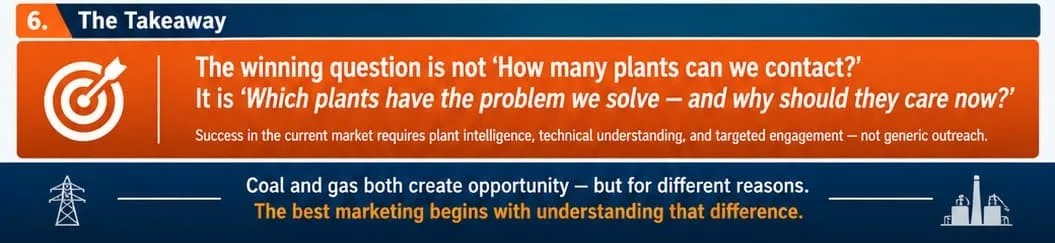
Coal and gas generation are both creating opportunities—but for different reasons.
Coal presents an aging fleet that, in selected cases, is being asked to remain operating longer and harder than expected.
Gas presents a highly utilized fleet where availability and outage flexibility are becoming increasingly valuable.
For technology and service providers, understanding that distinction should come before the first sales call.
Because in today's power market, the winning question is rarely:
"How many plants can we contact?"
It is:
"Which plants have the problem we solve—and why should they care about it now?"